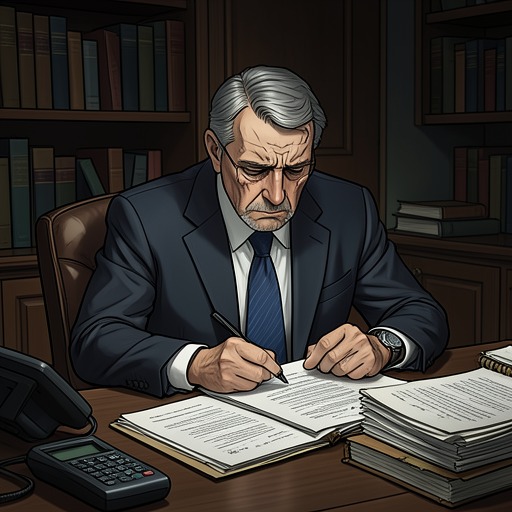
Great Benefit's claims file
The RainmakerGreat Benefit's claims file is the internal record at the center of Rudy Baylor's effort to show how the company handled the Black family's insurance claim. In a bad-faith case, the file can trace a claim handler's decisions through letters and other documents; here, its delayed delivery and conspicuous omission of the Stupid Letter make the record itself part of the dispute. The file matters both for what it contains and for what its absence may reveal.
Purpose and Stakes
The file is described as a collection of letters and documents maintained by the claims handler at Great Benefit's home office. It offers a chronological account of the company's treatment of a claim, potentially recording errors or decisions that the insurer would rather not expose. Rudy regards it as the heart of a bad-faith case and says he is entitled to receive it. The court had ordered it to be ready for him at the start of the Cleveland depositions, but it had not been delivered on time.
That delay acquires significance against the Blacks' own disclosure. At Dot Black's deposition, Rudy brought a complete copy of every document relating to the claim, including Donny Ray Black's medical records. The material was arranged for inspection, and, as Rudy saw it, the plaintiffs had no damaging documents to hide. Tyrone Kipler had reviewed the stack, and Leo F. Drummond could examine it. The contrast is pointed: the family makes its records available while questions gather around the insurer's production.
The Cleveland Production
Rudy arrives in Cleveland expecting to take depositions from six Great Benefit witnesses in the order he chooses under Kipler's order. He insists on beginning with claims handler Jackie Lemancyzk and asks for the file first. The company representatives instead disclose that Lemancyzk has left, that junior claims examiner Tony Krick has also gone, and that Russell Krokit, a former senior claims supervisor, has departed for another company. Richard Pellrod, Everett Lufkin, and Jack Underhall remain available. The departures intensify Rudy's concern about access to the people and records needed to understand the claim.
The file finally appears as a neatly copied, bound stack nearly five inches thick. Rudy asks whether it is in chronological order, as the court's order requires; the company representative can only say that he thinks it is. Rudy takes an hour to review it. The volume suggests a substantial administrative record, but its size does not guarantee completeness: his initial scan identifies a critical omission.
The Missing Letter
The Stupid Letter is not in the file. This is especially striking because Dot had handed a copy to Drummond at her deposition the previous week. Rudy had stamped COPY across the top three times so that the source of any later copy could be identified, while keeping the original secured in his own files. Great Benefit's attorneys had seen the letter for the first time at Dot's deposition; Rudy reasons that sending their marked copy back to the company to insert belatedly into the file would have been risky.
When Rudy raises the omission with Kipler by telephone, the judge asks the company representative whether it is true. The representative says he has not checked everything in the file. The missing letter therefore becomes more than a gap in a large production: it is a test of whether the company has complied with the order and disclosed the records relevant to its handling of the claim. Kipler responds to the broader situation by directing Rudy to question Underhall about the absent employees and to obtain the underwriting file as well. The claims file thus leads outward, toward further records and questions about the insurer's internal process.
From Record to Trial Evidence
At trial, the claim's paper history is presented alongside the people affected by it. Dot identifies and reads the denial letters, whose explanations change: the claim is rejected outright, referred between claims and underwriting, denied on preexisting-condition grounds, denied because Donny Ray is an adult and supposedly outside the household, and then rejected on grounds concerning transplant coverage and whether the treatment is experimental. The Stupid Letter follows these earlier denials. Its language, read aloud twice, leaves the courtroom silent and visibly alters the jurors' attention.
The file's significance is not confined to a single missing document. Rudy later connects the hidden documents and Great Benefit's conduct to testimony from Jackie Lemancyzk and to company statistics about policies, claims, and denials in 1991. In his closing, he frames those materials as evidence that the company instituted a year-long scheme to deny legitimate claims. The claim file helps transform a technical insurance dispute into a sequence the jury can follow: the family's request for treatment, the insurer's successive reasons for refusing it, and the records that expose the handling behind those refusals.
Narrative and Legal Significance
The file functions as both evidence and a measure of unequal access. Great Benefit controls the home-office records and initially fails to provide the file by the court-ordered deadline; Rudy must press for it, inspect it under pressure, and identify an omission before he can test the company's account through depositions. By contrast, the Blacks' documents are ready for scrutiny. That imbalance gives the file a dramatic role: discovery is not merely the exchange of paperwork but a contest over who can see the history of a claim and when.
Its incompleteness also makes the record consequential beyond its physical contents. The missing Stupid Letter links the deposition disclosure to the later trial presentation, while the order to secure the underwriting file points toward a larger investigation of how claims and underwriting interacted. As the case develops, the file becomes a route from individual denials to evidence about corporate practice, allowing the jury to consider the Black family's experience within a pattern rather than as an isolated disagreement.